The Sunday Times, Scotland
Marc Horne
IT MAY have happened 40 years ago, but England’s World Cup win against West Germany at Wembley remains a painful scar on the Scottish psyche.
Now a Highland distillery has committed what some will regard as the ultimate act of betrayal — dedicating a whisky to England’s greatest sporting triumph.
The Tullibardine distillery in Blackford, Perthshire, is to launch a 1966 vintage single malt. It aims to use the occasion to encourage Scots to support England at this summer’s World Cup in Germany.
Almost 400 bottles of the 1966 World Cup Vintage, complete with a label eulogising England’s triumph, will go on sale next month.
Read more...
Sunday, April 23, 2006

McDonald’s to flip tactics as health fad bites
The Sunday Times
By Mark Kleinman
Restaurant closures and new-format eateries herald a change in vision for Europe by the fast-food giant.
Read more...
By Mark Kleinman
Restaurant closures and new-format eateries herald a change in vision for Europe by the fast-food giant.
Read more...
Saturday, April 22, 2006
The Thomas Cubitt
The Times
By Giles Coren
"How grim to skulk in the shadows all one’s life like some hooded urban phone-grabber?"
For the past couple of weeks, all the talk between mouthfuls in that scary world where gastronomy and literature mix (and generally curdle) has been of a book called Garlic and Sapphires, Ruth Reichl’s memoir of her years as restaurant critic of The New York Times. Indeed, if I had a pound for every literary editor who has asked me to review it for him, I’d have two pounds.
Read more...
By Giles Coren
"How grim to skulk in the shadows all one’s life like some hooded urban phone-grabber?"
For the past couple of weeks, all the talk between mouthfuls in that scary world where gastronomy and literature mix (and generally curdle) has been of a book called Garlic and Sapphires, Ruth Reichl’s memoir of her years as restaurant critic of The New York Times. Indeed, if I had a pound for every literary editor who has asked me to review it for him, I’d have two pounds.
Read more...
The Neapolitan timebomb
The Guardian
A Chef's Guide To Italy
By Giorgio Locatelli
It is, perhaps, the Neapolitans we have to thank most of all for making the rest of the world aware of Italian food. When people think of my country's cooking, they think immediately of pizza or of spaghetti with tomato sauce - both native to Naples. However, the renown of those dishes has sometimes worked against Neapolitan cuisine in that they have tended to overshadow many other great dishes from the region.
Read more...
A Chef's Guide To Italy
By Giorgio Locatelli
It is, perhaps, the Neapolitans we have to thank most of all for making the rest of the world aware of Italian food. When people think of my country's cooking, they think immediately of pizza or of spaghetti with tomato sauce - both native to Naples. However, the renown of those dishes has sometimes worked against Neapolitan cuisine in that they have tended to overshadow many other great dishes from the region.
Read more...
Five Best: British cookery courses
The Independent
By Lucy Taylor
Perfect your pavé - then sit back and watch the star chefs at work.
1. Le Manoir aux Quat' Saisons, Oxon
2. Nick Nairn, Perthshire
3. Rick Stein, Cornwall
4. New Angel, Devon
5. L'Enclume, Cumbria
Read more...
By Lucy Taylor
Perfect your pavé - then sit back and watch the star chefs at work.
1. Le Manoir aux Quat' Saisons, Oxon
2. Nick Nairn, Perthshire
3. Rick Stein, Cornwall
4. New Angel, Devon
5. L'Enclume, Cumbria
Read more...
Culinary pleasures, literally
The Guardian
Jeremy Wayne books the best tables for reading and eating.
Cinnamon Club
Library At The Rubens
Langan's Brasserie
Read more...
Jeremy Wayne books the best tables for reading and eating.
Cinnamon Club
Library At The Rubens
Langan's Brasserie
Read more...
Friday, April 21, 2006
Eat up or pay up
The Guardian
One London restaurant is cracking down on greedy customers who pile up their plates, then leave loads of food. It fines them. Emily Ashton finds out why.
Read more...
One London restaurant is cracking down on greedy customers who pile up their plates, then leave loads of food. It fines them. Emily Ashton finds out why.
Read more...
Camel's milk could hit UK shelves
BBC News
Camel's milk could become the latest super food to hit the shelves of health food shops and upmarket retailers.
The United Nations is calling for the milk, which is rich in vitamins B and C and has 10 times more iron than cow's milk, to be sold to the West.
Camel's milk, which is slightly saltier than traditional milk, is drunk widely across the Arab world and is well suited to cheese production.
Harrods and Fortnum & Mason are said to be interested in the product.
Read more...
Camel's milk could become the latest super food to hit the shelves of health food shops and upmarket retailers.
The United Nations is calling for the milk, which is rich in vitamins B and C and has 10 times more iron than cow's milk, to be sold to the West.
Camel's milk, which is slightly saltier than traditional milk, is drunk widely across the Arab world and is well suited to cheese production.
Harrods and Fortnum & Mason are said to be interested in the product.
Read more...
Thursday, April 20, 2006
Chef's tips
The Times
Some tips by BRETT GRAHAM, Head chef, the Ledbury (020-7792 9090)
* The night before you cook rhubarb, dust it with sugar and orange zest. When you cook it, wrap it in tinfoil, lay it on a tray and cook at 130C for about 50minutes. The rhubarb will be able to cook in its own juice and keep more of its flavour than if it was boiled.
* To peel tomatoes easily without a blow torch, first score the tomatoes, then hold them to a naked flame with a skewer. After a few seconds, put them in iced water.
* Instead of boiling potatoes before you mash them, bake them. Scoop out the potato from the skins and put the potato through a drum sieve or a potato ricer. The mash will be drier, so you can add more butter, cream or milk. It will also have a stronger potato flavour.
* When you are making parfait, crack open a few peach stones and extract the kernels. Toast them in the oven, then chop or crush them and blend them into the parfait cream. It will give an extra almond taste to your parfait.
* To keep herbs fresh for longer, wet a clean J-cloth with cold water and wring it out, then wrap the herbs in it and keep in the fridge. This works best with soft herbs such as parsley, chervil, coriander and basil.
* If you are trying to get soft-boiled quail’s eggs out of their shells, soak them in malt vinegar at room temperature for a minute. The shells should peel off easily afterwards.
The original article
Some tips by BRETT GRAHAM, Head chef, the Ledbury (020-7792 9090)
* The night before you cook rhubarb, dust it with sugar and orange zest. When you cook it, wrap it in tinfoil, lay it on a tray and cook at 130C for about 50minutes. The rhubarb will be able to cook in its own juice and keep more of its flavour than if it was boiled.
* To peel tomatoes easily without a blow torch, first score the tomatoes, then hold them to a naked flame with a skewer. After a few seconds, put them in iced water.
* Instead of boiling potatoes before you mash them, bake them. Scoop out the potato from the skins and put the potato through a drum sieve or a potato ricer. The mash will be drier, so you can add more butter, cream or milk. It will also have a stronger potato flavour.
* When you are making parfait, crack open a few peach stones and extract the kernels. Toast them in the oven, then chop or crush them and blend them into the parfait cream. It will give an extra almond taste to your parfait.
* To keep herbs fresh for longer, wet a clean J-cloth with cold water and wring it out, then wrap the herbs in it and keep in the fridge. This works best with soft herbs such as parsley, chervil, coriander and basil.
* If you are trying to get soft-boiled quail’s eggs out of their shells, soak them in malt vinegar at room temperature for a minute. The shells should peel off easily afterwards.
The original article
Monday, April 17, 2006
Marketing Green & Black's: Organic plus luxury adds up to the taste of success
The Independent
Easter means chocolate, and for ever-growing numbers of consumers, chocolate means Green & Black's. Ian Burrell reports on one of the greatest marketing triumphs of recent years.
Read more...
Easter means chocolate, and for ever-growing numbers of consumers, chocolate means Green & Black's. Ian Burrell reports on one of the greatest marketing triumphs of recent years.
Read more...
Sunday, April 16, 2006
Food & drink special: When Michael met Elizabeth
The Independent
In 1966, Elizabeth David was a culinary legend who guarded her privacy fiercely. Michael Bateman was a young food writer. Securing this rare interview was the coup that made his name.
Read more...
In 1966, Elizabeth David was a culinary legend who guarded her privacy fiercely. Michael Bateman was a young food writer. Securing this rare interview was the coup that made his name.
Read more...
Why we cough up for a cup of coffee
The Sunday Times
Reviewed by DAVID SMITH
THE UNDERCOVER ECONOMIST by Tim Harford
Little, Brown £17.99 pp288
The question why a cup of coffee costs so much has engaged philosophers and pundits, particularly in America, for years. How did Starbucks get people to pay $2 for something they were used to paying 25 and 50 cents for? The answer, of course, has implications beyond caffeine. Without the $2 cup of coffee there would not be a Starbucks (and similar coffee chains) in every town and mall in America. And without that, it is doubtful the coffee phenomenon would have spread to Britain and around the world.
Tim Harford, in his entertaining application of economic principles to everyday life, takes us back to David Ricardo, the great English classical economist, to explain coffee prices.
Read more...
Reviewed by DAVID SMITH
THE UNDERCOVER ECONOMIST by Tim Harford
Little, Brown £17.99 pp288
The question why a cup of coffee costs so much has engaged philosophers and pundits, particularly in America, for years. How did Starbucks get people to pay $2 for something they were used to paying 25 and 50 cents for? The answer, of course, has implications beyond caffeine. Without the $2 cup of coffee there would not be a Starbucks (and similar coffee chains) in every town and mall in America. And without that, it is doubtful the coffee phenomenon would have spread to Britain and around the world.
Tim Harford, in his entertaining application of economic principles to everyday life, takes us back to David Ricardo, the great English classical economist, to explain coffee prices.
Read more...
Friday, April 14, 2006
Chocolate: The food of the Gods
The Independent
It was revealed this week that we are the biggest chocoholics in Europe. As we prepare to eat 80 million Easter eggs, Jonathan Brown and Eleanor Barham examine the lure of brown gold.
The history
The production
The health debate
The cultural significance
The new wave
Read more…
It was revealed this week that we are the biggest chocoholics in Europe. As we prepare to eat 80 million Easter eggs, Jonathan Brown and Eleanor Barham examine the lure of brown gold.
The history
The production
The health debate
The cultural significance
The new wave
Read more…
Thursday, April 13, 2006
Britons are Europe's biggest chocolate-lovers
The Independent
By Louise Barnett
Britons are the biggest chocoholics in Europe, munching through an average 10kg (22lb) per year, figures show.
The national sweet tooth cost an average £72 per person last year, compared to the Italians, who spent £18, the market analysts Datamonitor said.
Read more…
By Louise Barnett
Britons are the biggest chocoholics in Europe, munching through an average 10kg (22lb) per year, figures show.
The national sweet tooth cost an average £72 per person last year, compared to the Italians, who spent £18, the market analysts Datamonitor said.
Read more…
Wednesday, April 12, 2006
Monster egg goes on sale in Piccadilly shop for £50,000
The Independent
By Martin Hickman, Consumer Affairs Correspondent
Even by the standards of a London food scene that has marketed such extravagances as an £108 bowl of soup, the cost of this chocolate Easter egg may shock the unsuspecting shopper.
The "Diamond Stella Egg" going on sale at the Piccadilly shop La Maison Du Chocolat outshines previous examples of gourmet conspicuous consumption - with a price tag of £50,000. Two guards will protect the egg when the shop opens at 10am today.
Read more…
By Martin Hickman, Consumer Affairs Correspondent
Even by the standards of a London food scene that has marketed such extravagances as an £108 bowl of soup, the cost of this chocolate Easter egg may shock the unsuspecting shopper.
The "Diamond Stella Egg" going on sale at the Piccadilly shop La Maison Du Chocolat outshines previous examples of gourmet conspicuous consumption - with a price tag of £50,000. Two guards will protect the egg when the shop opens at 10am today.
Read more…
Bully for you, El Bulli
The Guardian, G2
By Heston Blumenthal
I heard that my restaurant the Fat Duck had come second in the 2006 World's 50 Best restaurant awards a couple of days ago, and I have to say I think it's almost a better result than last year, when I won. And I'm really pleased that Ferran Adrià's El Bulli has won. He and I have been good friends for years. ...
Read more…
By Heston Blumenthal
I heard that my restaurant the Fat Duck had come second in the 2006 World's 50 Best restaurant awards a couple of days ago, and I have to say I think it's almost a better result than last year, when I won. And I'm really pleased that Ferran Adrià's El Bulli has won. He and I have been good friends for years. ...
Read more…
Tuesday, April 11, 2006
A boozy dinner is best way to break the ice
The Times
By Julian Evans
RUSSIANS have a reputation for being cold and unfriendly.
But nothing could be further from the truth. In fact, they are a warm and emotional people.
The key to doing business in Russia is getting things on to a personal footing. You could do this by bringing a present from Britain to your business client. Russians love all things British, particularly luxury items from Harrods, Fortnum & Mason and Burberry. Souvenirs from Chelsea Football Club also go down well.
Having a boozy dinner is the best way to break the ice. Proposing long and sentimental toasts is also a good idea, but never sip your vodka — it should go down in one gulp.
Read more...
By Julian Evans
RUSSIANS have a reputation for being cold and unfriendly.
But nothing could be further from the truth. In fact, they are a warm and emotional people.
The key to doing business in Russia is getting things on to a personal footing. You could do this by bringing a present from Britain to your business client. Russians love all things British, particularly luxury items from Harrods, Fortnum & Mason and Burberry. Souvenirs from Chelsea Football Club also go down well.
Having a boozy dinner is the best way to break the ice. Proposing long and sentimental toasts is also a good idea, but never sip your vodka — it should go down in one gulp.
Read more...
How does the £85 sandwich taste? In a word: rich
The Guardian
By Maev Kennedy
* Huge lunch on sale at London department store
* It's not a gimmick, says chef who created it
The women stopped, gaped, peered more closely to make sure they hadn't missed a decimal point, and then laughed. The fat sandwich, under a glass dome on the Selfridge's deli counter, was indeed labelled £85.
Read more...
By Maev Kennedy
* Huge lunch on sale at London department store
* It's not a gimmick, says chef who created it
The women stopped, gaped, peered more closely to make sure they hadn't missed a decimal point, and then laughed. The fat sandwich, under a glass dome on the Selfridge's deli counter, was indeed labelled £85.
Read more...
In praise of ... Heston Blumenthal
The Guardian, Leader
His restaurant, the Fat Duck at Bray, was only voted the second best in the world this year after being chosen as the very best in 2005, but that is something he can live with. To finish in the top two for two consecutive years is something Heston Blumenthal - and the rest of the country - can be truly proud of. This year he lost to the celebrated El Bulli in Spain, which has been in the top three every year since Restaurant Magazine started the exercise in 2002.
Read more…
His restaurant, the Fat Duck at Bray, was only voted the second best in the world this year after being chosen as the very best in 2005, but that is something he can live with. To finish in the top two for two consecutive years is something Heston Blumenthal - and the rest of the country - can be truly proud of. This year he lost to the celebrated El Bulli in Spain, which has been in the top three every year since Restaurant Magazine started the exercise in 2002.
Read more…
Fat Duck loses out to El Bulli in world top 50
The Guardian
By Patrick Barkham
After winning last year, British chef Heston Blumenthal's Fat Duck had to settle for second place in the World's 50 Best Restaurants awards as Ferran Adria's El Bulli in rural Spain returned to the top spot it first claimed four years ago.
Blumenthal fared better than many British chefs under new rules devised by Restaurant Magazine. Last year, 14 of the top 50 were British; this year, there were six. Nobu was 12th, and Gordon Ramsay at 68 Royal Hospital Road, 14th.
Michel Roux Jr's Le Gavroche won an outstanding value award, while St John and Hakkasan were also in the top 40.
Read the original
By Patrick Barkham
After winning last year, British chef Heston Blumenthal's Fat Duck had to settle for second place in the World's 50 Best Restaurants awards as Ferran Adria's El Bulli in rural Spain returned to the top spot it first claimed four years ago.
Blumenthal fared better than many British chefs under new rules devised by Restaurant Magazine. Last year, 14 of the top 50 were British; this year, there were six. Nobu was 12th, and Gordon Ramsay at 68 Royal Hospital Road, 14th.
Michel Roux Jr's Le Gavroche won an outstanding value award, while St John and Hakkasan were also in the top 40.
Read the original
Monday, April 10, 2006
It should have been one of the great vintages - but they just couldn't leave well alone
The Times
From Jane MacQuitty in Bordeaux and Adam Sage in Paris
IT WAS predicted to be a classic vintage to rival the best postwar clarets and to rescue vineyards in decline. To the winemakers of Bordeaux, 2005 was going to be their saviour.
Heady comparisons with the great years of 1961 and 1982, which set new standards for the world’s finest and largest red wine region, have been rife.
But, while many vineyards will have the claret of the century on their hands, as many as a quarter of the region’s 14,000 wine producers could have bungled the opportunity by excessive use of high- tech equipment and clumsy techniques.
They had a textbook vintage, created by sunny days, cool nights and a long, disease-free growing season that culminated in a warm, dry harvest. But some producers could not resist the temptation to meddle with their wines and, in doing so, they have caused another setback for Bordeaux and the French wine industry.
Read more...
From Jane MacQuitty in Bordeaux and Adam Sage in Paris
IT WAS predicted to be a classic vintage to rival the best postwar clarets and to rescue vineyards in decline. To the winemakers of Bordeaux, 2005 was going to be their saviour.
Heady comparisons with the great years of 1961 and 1982, which set new standards for the world’s finest and largest red wine region, have been rife.
But, while many vineyards will have the claret of the century on their hands, as many as a quarter of the region’s 14,000 wine producers could have bungled the opportunity by excessive use of high- tech equipment and clumsy techniques.
They had a textbook vintage, created by sunny days, cool nights and a long, disease-free growing season that culminated in a warm, dry harvest. But some producers could not resist the temptation to meddle with their wines and, in doing so, they have caused another setback for Bordeaux and the French wine industry.
Read more...
'Most expensive sandwich' on sale
BBC News
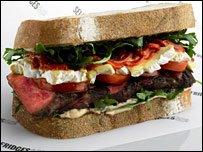
 Hungry shoppers are being offered the chance to eat a gourmet sandwich, but the £85 price tag might be too much for some to swallow.
The McDonald sandwich - named after its creator Scott McDonald, the chef at London department store Selfridges - is said to be the world's most expensive.
Its cost is down to the Wagyu beef that makes up most of the filling, packed in a 24-hour fermented sour dough bread.
Read more…
Photo from BBC News
 Hungry shoppers are being offered the chance to eat a gourmet sandwich, but the £85 price tag might be too much for some to swallow.
 The McDonald sandwich - named after its creator Scott McDonald, the chef at London department store Selfridges - is said to be the world's most expensive.
Its cost is down to the Wagyu beef that makes up most of the filling, packed in a 24-hour fermented sour dough bread.
Read more…
Photo from BBC News
Culture choc
The Times, S2
By Sarah Vine
It's no longer just chocolate, it's a fashion statement. So what does your Easter egg say about you? Our correspondent explains, and our tasting panel gives its verdict on a dozen eggs.
Read more...
By Sarah Vine
It's no longer just chocolate, it's a fashion statement. So what does your Easter egg say about you? Our correspondent explains, and our tasting panel gives its verdict on a dozen eggs.
Read more...
Sunday, April 09, 2006
A chocolate a day...
The Sunday Times
Comment
The ancient Mayans drank it for fertility, and the Spanish conquistadores ground it into paste and ate it to calm their stomachs and cure catarrh. Now the good news is that we are encouraged to eat chocolate to stay healthy. A London professor is prescribing chocolate to patients with cardiovascular disease to test whether the flavanols in it improve their condition, chocolate’s beneficial effects on blood flow being known. Mars is developing a chocolate-style medicine to be used to treat diabetes, strokes, dementia and heart disease. A few chocs daily may prevent fatal diseases or even improve sex drive. We wish.
Read more...
Comment
The ancient Mayans drank it for fertility, and the Spanish conquistadores ground it into paste and ate it to calm their stomachs and cure catarrh. Now the good news is that we are encouraged to eat chocolate to stay healthy. A London professor is prescribing chocolate to patients with cardiovascular disease to test whether the flavanols in it improve their condition, chocolate’s beneficial effects on blood flow being known. Mars is developing a chocolate-style medicine to be used to treat diabetes, strokes, dementia and heart disease. A few chocs daily may prevent fatal diseases or even improve sex drive. We wish.
Read more...
Sweet taste of Britain's A-list? Sorry, it's off
The Observer
UK menus ruled the World's Top 50 last year. This year we are nowhere. Restaurant critic of the year Jay Rayner asks why.
Read more…
UK menus ruled the World's Top 50 last year. This year we are nowhere. Restaurant critic of the year Jay Rayner asks why.
Read more…
Friday, April 07, 2006
Soundbites: Pasta master
The Guardian, G2
By Alex Kapranos
There's a wok full of pasta tubes glistening green on the stove. They're delicious. Jessica is cooking tonight. Her husband Bill is rewiring a 10-channel Flickinger pre-amp into Sly Stone's old mixing desk. Sly's old roaches still lie among the circuitry. Bill and Jessica own the Key Club Studio in Benton Harbor, Michigan, where we are recording for a few days.
Read more…
By Alex Kapranos
There's a wok full of pasta tubes glistening green on the stove. They're delicious. Jessica is cooking tonight. Her husband Bill is rewiring a 10-channel Flickinger pre-amp into Sly Stone's old mixing desk. Sly's old roaches still lie among the circuitry. Bill and Jessica own the Key Club Studio in Benton Harbor, Michigan, where we are recording for a few days.
Read more…
New rules issued to ensure food safety
The Independent
By Martin Hickman, Consumer Affairs Correspondent
Restaurants have been told to stop preparing gourmet dishes consisting of raw eggs and half-cooked poultry to eliminate any risk of catching bird flu.
The Food Standards Agency is advising the food industry and the public only to serve meat where the juices run clear and eggs that have solid whites.
Read more...
By Martin Hickman, Consumer Affairs Correspondent
Restaurants have been told to stop preparing gourmet dishes consisting of raw eggs and half-cooked poultry to eliminate any risk of catching bird flu.
The Food Standards Agency is advising the food industry and the public only to serve meat where the juices run clear and eggs that have solid whites.
Read more...
Thursday, April 06, 2006
Blumenthal's online archive to preserve recipes for posterity
The Independent
By Martin Hickman, Consumer Affairs Correspondent
Heston Blumenthal, the self-taught chef whose restaurant in Berkshire has been judged the best in the world, is starting an internet archive to record his food experiments.
The cook has two full-time staff extending the boundaries of culinary science in a kitchen laboratory, but until now their work has been filed away. The computer database will help Blumenthal analyse the results of his experiments and preserve them for posterity.
Read more…
By Martin Hickman, Consumer Affairs Correspondent
Heston Blumenthal, the self-taught chef whose restaurant in Berkshire has been judged the best in the world, is starting an internet archive to record his food experiments.
The cook has two full-time staff extending the boundaries of culinary science in a kitchen laboratory, but until now their work has been filed away. The computer database will help Blumenthal analyse the results of his experiments and preserve them for posterity.
Read more…
Wednesday, April 05, 2006
Why we have a high old time on chocolate
The Times, S2
By Dr Thomas Stuttaford
People have always enjoyed the effect of cocoa. As the Easter egg season approaches, we explain why
Bacchus, the god of wine, is often linked with regeneration. Nothing looks as dead as a vine in winter, but come the spring few other plants look so bright and vernal. It is an annual example that out of death comes life. Whereas the followers of Bacchus had vines and wine as examples of everlasting life and annual renewal, we now have to make do with chocolate Easter eggs.
Every year spring is heralded by the appearance of Easter eggs at sweet shops, supermarkets, newsagents and garages.
If wine was Bacchus’s tipple of choice, the Aztecs and Mayans opted for cocoa.
Read more...
By Dr Thomas Stuttaford
People have always enjoyed the effect of cocoa. As the Easter egg season approaches, we explain why
Bacchus, the god of wine, is often linked with regeneration. Nothing looks as dead as a vine in winter, but come the spring few other plants look so bright and vernal. It is an annual example that out of death comes life. Whereas the followers of Bacchus had vines and wine as examples of everlasting life and annual renewal, we now have to make do with chocolate Easter eggs.
Every year spring is heralded by the appearance of Easter eggs at sweet shops, supermarkets, newsagents and garages.
If wine was Bacchus’s tipple of choice, the Aztecs and Mayans opted for cocoa.
Read more...
Tuesday, April 04, 2006
Fancy lunch? Great ... what's your name?
The Guardian, page 1
By Oliver Burkeman in New York
Jared Nissim wanted to make one thing clear. "This is definitely not a dating service," the 32-year-old New Yorker explained, as a motley group of 18 men and women, many unknown to each other, gathered around a long table at a Manhattan restaurant.
"If I ran this as a dating service, you'd just get a bunch of guys trolling for women. And then the women wouldn't show up, because they'd know it was just a bunch of guys trolling for them. So eventually there'd be no women to troll for. And at that point," he concluded, with unarguable logic, "even the guys wouldn't show up."
Exactly the opposite has happened with the Lunch Club, the organisation Mr Nissim founded in 2001 to combat his isolation as a bachelor living alone and working from home in New York. He wasn't looking for romance, just for friends, so he posted a speculative message on Craig's List, the website millions of Americans use to arrange everything from apartment rentals to random sexual encounters. Did anyone, he inquired, want to join him for lunch?
Read more…
By Oliver Burkeman in New York
Jared Nissim wanted to make one thing clear. "This is definitely not a dating service," the 32-year-old New Yorker explained, as a motley group of 18 men and women, many unknown to each other, gathered around a long table at a Manhattan restaurant.
"If I ran this as a dating service, you'd just get a bunch of guys trolling for women. And then the women wouldn't show up, because they'd know it was just a bunch of guys trolling for them. So eventually there'd be no women to troll for. And at that point," he concluded, with unarguable logic, "even the guys wouldn't show up."
Exactly the opposite has happened with the Lunch Club, the organisation Mr Nissim founded in 2001 to combat his isolation as a bachelor living alone and working from home in New York. He wasn't looking for romance, just for friends, so he posted a speculative message on Craig's List, the website millions of Americans use to arrange everything from apartment rentals to random sexual encounters. Did anyone, he inquired, want to join him for lunch?
Read more…
Food companies 'failing to tackle diet crisis'
The Independent
By Cahal Milmo
The world's 25 biggest food companies are failing to take the global crisis in diet seriously and often only change their practices when faced with adverse publicity that could damage their sales, a new study claims.
From Wal-Mart to Aldi and McDonald's to Coca-Cola, the world leaders of the food industry are accused of a "pathetic" performance on meeting targets set by the World Health Organisation (WHO) in 2004 to tackle obesity, heart disease, cancer and diabetes.
Read more…
By Cahal Milmo
The world's 25 biggest food companies are failing to take the global crisis in diet seriously and often only change their practices when faced with adverse publicity that could damage their sales, a new study claims.
From Wal-Mart to Aldi and McDonald's to Coca-Cola, the world leaders of the food industry are accused of a "pathetic" performance on meeting targets set by the World Health Organisation (WHO) in 2004 to tackle obesity, heart disease, cancer and diabetes.
Read more…
Monday, April 03, 2006
Blogger's culinary odyssey awarded literary honour
The Independent, Home, P. 17
By Cahal Milmo
The Blooker Prize, established to reward books born on the web, aims to highlight the potential of the blogging culture to create, if not poetic gems, then at least mainstream fiction and non-fiction.
The award was given to Julie Powell, a former secretary in New York for her book, Julie and Julia, based on her blog which chronicled her campaign to cook all 524 recipes in a classic French cookbook in her small kitchen in a year.
Since publication, the blook has sold 100,000 copies and secured its author a publishing contract.
Read more…
By Cahal Milmo
The Blooker Prize, established to reward books born on the web, aims to highlight the potential of the blogging culture to create, if not poetic gems, then at least mainstream fiction and non-fiction.
The award was given to Julie Powell, a former secretary in New York for her book, Julie and Julia, based on her blog which chronicled her campaign to cook all 524 recipes in a classic French cookbook in her small kitchen in a year.
Since publication, the blook has sold 100,000 copies and secured its author a publishing contract.
Read more…
Sweden's pungent herring treat is grounded by airlines
The Independent, Europe
By Jerome Taylor
Surstromming, the highly pungent but much-loved Swedish dish of fermented herring, has a habit of offending the uninitiated with its peculiar taste and overpowering smell of rotten garbage.
But now the national favourite, traditionally devoured in the summer months with large quantities of highly alcoholic liquor, has fallen foul of the airline industry which has asked passengers not to take it on board, saying it poses a safety risk.
Read more…
By Jerome Taylor
Surstromming, the highly pungent but much-loved Swedish dish of fermented herring, has a habit of offending the uninitiated with its peculiar taste and overpowering smell of rotten garbage.
But now the national favourite, traditionally devoured in the summer months with large quantities of highly alcoholic liquor, has fallen foul of the airline industry which has asked passengers not to take it on board, saying it poses a safety risk.
Read more…
The cookery rules that are made to be broken
The Times, Times 2
By Joanna Weinberg
In the kitchen there are no absolutes: For me the most joyful, terrifying, engaging, deflating fact about cooking is its disregard for exactitude.
Read more…
By Joanna Weinberg
In the kitchen there are no absolutes: For me the most joyful, terrifying, engaging, deflating fact about cooking is its disregard for exactitude.
Read more…
Wild harvest: the edible delights of the countryside
The Independent, Life&Culture, Green Pages
By John Andrews
Miles Irving forages in the countryside for edible plants - then sells them to top chefs. It's a perfect marriage of conservation and commerce, he tells.
Read more…
By John Andrews
Miles Irving forages in the countryside for edible plants - then sells them to top chefs. It's a perfect marriage of conservation and commerce, he tells.
Read more…
Sunday, April 02, 2006
Châteauny Blair: Labour's staggering £1m wine bill
The Independent, Home News
By Marie Woolf and Raymond Whitaker
It's one of the Government's most closely guarded secrets. But we can reveal the contents of the fabled Whitehall cellar.
Nearly 40,000 of Britain's most closely guarded secrets are held in the vaults of Lancaster House, just off The Mall in London. The details are so sensitive that the Government has resisted several attempts under the Freedom of Information Act to have them made public.
Today, however, The Independent on Sunday is in a position to lift a corner of this shroud of secrecy. Since Tony Blair took office in 1997, we can reveal, New Labour has spent almost £1m of taxpayers' money on replenishing the supplies cellared under Lancaster House.
Read more... (registration needed)
By Marie Woolf and Raymond Whitaker
It's one of the Government's most closely guarded secrets. But we can reveal the contents of the fabled Whitehall cellar.
Nearly 40,000 of Britain's most closely guarded secrets are held in the vaults of Lancaster House, just off The Mall in London. The details are so sensitive that the Government has resisted several attempts under the Freedom of Information Act to have them made public.
Today, however, The Independent on Sunday is in a position to lift a corner of this shroud of secrecy. Since Tony Blair took office in 1997, we can reveal, New Labour has spent almost £1m of taxpayers' money on replenishing the supplies cellared under Lancaster House.
Read more... (registration needed)
Fantasy kitchens
Sunday Times
By Katrina Burroughs
With gas-lift hydraulics, steam ovens, leather and platinum, cooking in style is as important as practicality in the latest statement room.
The kitchen has always been the heart of the home; it’s also the place to really make a design statement and, if you have the cash, the sky’s the limit. Bespoke budgets often hit six figures. Chef Gordon Ramsay reportedly spent £500,000 on the kitchen at his home (including a £67,000 Rorgue cooker), but a beautiful kitchen is a must even for those who rarely lift an oven glove.
Read more…
By Katrina Burroughs
With gas-lift hydraulics, steam ovens, leather and platinum, cooking in style is as important as practicality in the latest statement room.
The kitchen has always been the heart of the home; it’s also the place to really make a design statement and, if you have the cash, the sky’s the limit. Bespoke budgets often hit six figures. Chef Gordon Ramsay reportedly spent £500,000 on the kitchen at his home (including a £67,000 Rorgue cooker), but a beautiful kitchen is a must even for those who rarely lift an oven glove.
Read more…
School meals revolution hits home
Sunday Times
By Deirdre Fernand
The dinner lady who teamed up with Jamie Oliver to kill off Turkey Twizzlers in schools is now encouraging children to take the message to their parents.
Read more…
By Deirdre Fernand
The dinner lady who teamed up with Jamie Oliver to kill off Turkey Twizzlers in schools is now encouraging children to take the message to their parents.
Read more…
Saturday, April 01, 2006
Obituaries: Michael Bateman
The Times
Michael Bateman: March 25 1932 - March 26, 2006
Gregarious food journalist who adventured in search of unfamiliar flavours and exotic ingredients.
Read more…
Michael Bateman: March 25 1932 - March 26, 2006
Gregarious food journalist who adventured in search of unfamiliar flavours and exotic ingredients.
Read more…
Friday, March 31, 2006
Cheap way to a heart of oak
The Times, Europe
By Robin Young
WINEMAKING is a tricky and complicated business, and winemakers are constantly in search of ways to make their work easier and their results more palatable at less expense of time, energy and money.
The use of oak chips to imbue cheap wine with oak flavour originated in Australia, where winemakers tended two decades ago to take a very practical and pragmatic attitude towards their craft. At that time there was a vogue for the sweetish, toasty, vanilla flavour which ageing in new oak barrels imparts.
Read more...
By Robin Young
WINEMAKING is a tricky and complicated business, and winemakers are constantly in search of ways to make their work easier and their results more palatable at less expense of time, energy and money.
The use of oak chips to imbue cheap wine with oak flavour originated in Australia, where winemakers tended two decades ago to take a very practical and pragmatic attitude towards their craft. At that time there was a vogue for the sweetish, toasty, vanilla flavour which ageing in new oak barrels imparts.
Read more...
Brave new world for French wine
The Times
By Charles Bremner
Wood chippings and even a splash of water will be allowed as vignerons fight to win back drinkers.
AS FRANCE recoiled before the advance of globalisation and of English as a lingua franca, there was one area in which it remained confident of its superiority: its wines.
Now even the vintners’ traditions are going the way of the five-course lunch, the Deux Chevaux and the surly waiter.
After failing to hold off the onslaught from New World winemakers, France is to join them in such heresies as adding wood chips and — perhaps — even watering down the wine. The Agriculture Minister has issued a plan to let vignerons compete with growers in the Antipodes and the Americas whose simple flavours and clever marketing have been winning the world’s wine drinkers.
“We have to make wine for consumers, not wine that producers dream of,” said Bernard Pomel, author of the plan, which is likely to be adopted soon as law.
Read more...
By Charles Bremner
Wood chippings and even a splash of water will be allowed as vignerons fight to win back drinkers.
AS FRANCE recoiled before the advance of globalisation and of English as a lingua franca, there was one area in which it remained confident of its superiority: its wines.
Now even the vintners’ traditions are going the way of the five-course lunch, the Deux Chevaux and the surly waiter.
After failing to hold off the onslaught from New World winemakers, France is to join them in such heresies as adding wood chips and — perhaps — even watering down the wine. The Agriculture Minister has issued a plan to let vignerons compete with growers in the Antipodes and the Americas whose simple flavours and clever marketing have been winning the world’s wine drinkers.
“We have to make wine for consumers, not wine that producers dream of,” said Bernard Pomel, author of the plan, which is likely to be adopted soon as law.
Read more...
Thursday, March 30, 2006
Belgian chocolatiers savour sweet taste of world domination
The Independent
By Stephen Castle in Brussels
Some time ago, a uniformed US Air Force officer from Nato headquarters arrived at Passion Chocolat, a tiny chocolatier in a suburban Brussels street, and threw staff into a panic by asking for 40 boxes of chocolate.
Their efforts to accommodate him were rewarded a few weeks later with a thank-you note - from the White House.
Read more… (registration needed)
By Stephen Castle in Brussels
Some time ago, a uniformed US Air Force officer from Nato headquarters arrived at Passion Chocolat, a tiny chocolatier in a suburban Brussels street, and threw staff into a panic by asking for 40 boxes of chocolate.
Their efforts to accommodate him were rewarded a few weeks later with a thank-you note - from the White House.
Read more… (registration needed)
Stop force-feeding junk food to children
The Independent, Comment
By Janet Street-Porter
How many more kids must ruin their health before these media mandarins feel any sense of responsibility?
Read more…
By Janet Street-Porter
How many more kids must ruin their health before these media mandarins feel any sense of responsibility?
Read more…
Tuesday, March 28, 2006
Cod taken off the shelves at Asda to preserve stocks
The Independent, Environment
By Martin Hickman, Consumer Affairs Correspondent
Asda, Britain's second biggest supermarket, is removing North Sea cod from its shelves in response to the dramatic collapse of natural fish stocks.
In a sign of how overfishing has devastated the once-plentiful cod off Britain's coast, the supermarket said that it would suspend sale of North Sea cod by July. It said the move had been influenced by attacks from environmentalists for its sale of endangered fish such as cod, which is heading towards commercial extinction in the waters off Britain.
Read more…
By Martin Hickman, Consumer Affairs Correspondent
Asda, Britain's second biggest supermarket, is removing North Sea cod from its shelves in response to the dramatic collapse of natural fish stocks.
In a sign of how overfishing has devastated the once-plentiful cod off Britain's coast, the supermarket said that it would suspend sale of North Sea cod by July. It said the move had been influenced by attacks from environmentalists for its sale of endangered fish such as cod, which is heading towards commercial extinction in the waters off Britain.
Read more…
Sunday, March 26, 2006
Food Safety: Salt
The Independent
By Cole Moreton
We love it. Food companies are refusing to cut it out for fear of losing customers. So just how dangerous can those white crystals really be?
Read more…
By Cole Moreton
We love it. Food companies are refusing to cut it out for fear of losing customers. So just how dangerous can those white crystals really be?
Read more…
Saturday, March 25, 2006
Country ripe for revolution
The Telegraph
Joanna Blythman talks veg with a man who plans to revamp our local greengrocers
The famously bookish inhabitants of Hay-on-Wye turned their thoughts to matters culinary this month, with the arrival of a shop that may well set a national trend.
Fresh crop: 'We need to take a look at how we source and sell fruit and veg' says Charlie Hicks, the infectiously enthusiastic co-presenter of Radio 4's Veg Talk, thinks Britain's greengrocer shops are ripe for a revival, but in a reconstructed form.
To illustrate the point, he has opened his own new-wave emporium in Hay.
Read more...
Joanna Blythman talks veg with a man who plans to revamp our local greengrocers
The famously bookish inhabitants of Hay-on-Wye turned their thoughts to matters culinary this month, with the arrival of a shop that may well set a national trend.
Fresh crop: 'We need to take a look at how we source and sell fruit and veg' says Charlie Hicks, the infectiously enthusiastic co-presenter of Radio 4's Veg Talk, thinks Britain's greengrocer shops are ripe for a revival, but in a reconstructed form.
To illustrate the point, he has opened his own new-wave emporium in Hay.
Read more...
Savvy shopper: canned food
The Telegraph
Rose Prince looks at how to buy canned food with peace of mind and a clear conscience
We might have recycled-glass mountains, but the British are notoriously poor at recycling steel, even though it is a far more essential material.
Canning is an enduringly popular way to preserve foods, surviving in spite of fridge-freezers, modified-atmosphere packaging and chemical preservatives.
Our attachment to cans is deep-rooted - think of all those late-night hunger pangs that have been solved by opening a tin.
Read more...
Rose Prince looks at how to buy canned food with peace of mind and a clear conscience
We might have recycled-glass mountains, but the British are notoriously poor at recycling steel, even though it is a far more essential material.
Canning is an enduringly popular way to preserve foods, surviving in spite of fridge-freezers, modified-atmosphere packaging and chemical preservatives.
Our attachment to cans is deep-rooted - think of all those late-night hunger pangs that have been solved by opening a tin.
Read more...
Super foods: pomegranate
The Telegraph
Judith Woods looks at the health-giving benefits of some of our most common foods. This week: pomegranate.
Read more...
Judith Woods looks at the health-giving benefits of some of our most common foods. This week: pomegranate.
Read more...
The power ranges
The Telegraph
Will a menu inspired by superfoods make you a kitchen hero, or is it a crime against taste, asks Tom Norrington-Davies.
Crispy fried mackerel and oatmeal
Blueberry smoothie
Red cabbage and roast sweet potato
Read more...
Will a menu inspired by superfoods make you a kitchen hero, or is it a crime against taste, asks Tom Norrington-Davies.
Crispy fried mackerel and oatmeal
Blueberry smoothie
Red cabbage and roast sweet potato
Read more...
Divide and rule
The Guardian
By Richard Johnson
Colonel DS Bradley's patent cake divider
The main attraction
To be sniffed at ...
Let's all go Slow
Read more...
By Richard Johnson
Colonel DS Bradley's patent cake divider
The main attraction
To be sniffed at ...
Let's all go Slow
Read more...
Eat it now: A wild food feast
The Guardian
By Nikki Duffy
If you fancy a walk in the country anytime soon, take a pair of Marigolds and a big bag, and reap yourself a harvest of nettles. There is something hugely satisfying about feasting on wild food you've collected yourself - and few grow with such abundance. Once you've vanquished their sting, nettles are delicious and nutritious. They behave a lot like spinach and can be served in similar ways, but the flavour is less sweet, more earthy.
Read more...
By Nikki Duffy
If you fancy a walk in the country anytime soon, take a pair of Marigolds and a big bag, and reap yourself a harvest of nettles. There is something hugely satisfying about feasting on wild food you've collected yourself - and few grow with such abundance. Once you've vanquished their sting, nettles are delicious and nutritious. They behave a lot like spinach and can be served in similar ways, but the flavour is less sweet, more earthy.
Read more...
Mountain wines
The Guardian
By Victoria Moore
Pic St-Loup is a mountain that sticks out of the limestone slopes to the north of Montpellier like one of those pointed plates on a stegosaurus's back. It rises out of the herb-infested scrubland with such authority that it has given its name to the red and rosé wines made in its vicinity from (predominantly) syrah, mourvèdre and grenache.
One of the fastest-rising stars of Languedoc, the Pic St-Loup wine region has not - yet - been granted an independent appellation contrôlée, existing for the time being as one of the so-called crus of the Coteaux du Languedoc AOC. But it does have an even harder to attain quality: buzz.
Read more...
By Victoria Moore
Pic St-Loup is a mountain that sticks out of the limestone slopes to the north of Montpellier like one of those pointed plates on a stegosaurus's back. It rises out of the herb-infested scrubland with such authority that it has given its name to the red and rosé wines made in its vicinity from (predominantly) syrah, mourvèdre and grenache.
One of the fastest-rising stars of Languedoc, the Pic St-Loup wine region has not - yet - been granted an independent appellation contrôlée, existing for the time being as one of the so-called crus of the Coteaux du Languedoc AOC. But it does have an even harder to attain quality: buzz.
Read more...
A simple pasta
The Guardian
A chef's guide to Italy: Giorgio Locatelli
Just the thought of a steaming bowlful of my grandmother's pasta e patate waiting for me on my return from school would make me run home that little bit faster. This succulent and simple combination is found right across Italy, where every region, province and village - and probably every household - is convinced of the superiority of their own recipe.
Read more...
A chef's guide to Italy: Giorgio Locatelli
Just the thought of a steaming bowlful of my grandmother's pasta e patate waiting for me on my return from school would make me run home that little bit faster. This succulent and simple combination is found right across Italy, where every region, province and village - and probably every household - is convinced of the superiority of their own recipe.
Read more...
Friday, March 24, 2006
Can you copyright a dish?
The Guardian
By Paul Lewis
That's the question raging in the food world this week after a chef in Australia was accused of copying the signature dish of a New York restaurant.
Read more...
By Paul Lewis
That's the question raging in the food world this week after a chef in Australia was accused of copying the signature dish of a New York restaurant.
Read more...
Pernod tops up annual earnings growth forecast
The Guardian, Financial
By Simon Bowers
Pernod Ricard, the French drinks group which last year acquired its larger British rival Allied Domecq for £7.4bn, said yesterday it was making better progress than expected integrating the two businesses.
The group raised earnings per share growth guidance for the year to the end of June, targeting "the top" of its previous 10-15% range. Former Allied brands Kahlua and Sauza were said to be "struggling".
Read more...
By Simon Bowers
Pernod Ricard, the French drinks group which last year acquired its larger British rival Allied Domecq for £7.4bn, said yesterday it was making better progress than expected integrating the two businesses.
The group raised earnings per share growth guidance for the year to the end of June, targeting "the top" of its previous 10-15% range. Former Allied brands Kahlua and Sauza were said to be "struggling".
Read more...
Wednesday, March 22, 2006
Gluttony is good for you
The Guardian
By Zoe Williams, columnist
Eat up. The fatter you are, the less likely you are to get depressed and commit suicide.
Read more…
By Zoe Williams, columnist
Eat up. The fatter you are, the less likely you are to get depressed and commit suicide.
Read more…
Gluttony isn't the worst sin
The Guardian
By Zoe Williams, columnist
Dieting is self-indulgent - it lets you fulfil your quota of worry without thinking of anyone else
Read more…
By Zoe Williams, columnist
Dieting is self-indulgent - it lets you fulfil your quota of worry without thinking of anyone else
Read more…
Jamie Oliver extends Sainsbury's ad contract
The Guardian
By Julia Day
Celebrity chef Jamie Oliver will continue to encourage the nation's shoppers to "Try something new" at Sainsbury's, after signing a new contract to star in the supermarket's adverts. The new one-year contract extension will take Oliver's association with Sainsbury's into its seventh year, during which time he has gone from a cheeky chappie "naked chef" to the high-profile and (...)
Read more in MediaGuardian (registration needed)
By Julia Day
Celebrity chef Jamie Oliver will continue to encourage the nation's shoppers to "Try something new" at Sainsbury's, after signing a new contract to star in the supermarket's adverts. The new one-year contract extension will take Oliver's association with Sainsbury's into its seventh year, during which time he has gone from a cheeky chappie "naked chef" to the high-profile and (...)
Read more in MediaGuardian (registration needed)
Tuesday, March 21, 2006
Labelling the point
The Guardian
By Sarah Lelic
Major food industry players may come to regret their lack of enthusiasm for a new nutrition information system.
Read more…
By Sarah Lelic
Major food industry players may come to regret their lack of enthusiasm for a new nutrition information system.
Read more…
Scientists warn parents on pesticides and plastics
The Guardian
By Polly Curtis, health correspondent
Parents were yesterday warned by researchers that levels of pesticides previously thought to be harmless could cause cancers in babies and young children.
Liverpool University scientists argue that low levels of chemicals from pesticides and plastics could affect the development of babies before they are born and increase their likelihood of developing cancer later in life.
Read more…
By Polly Curtis, health correspondent
Parents were yesterday warned by researchers that levels of pesticides previously thought to be harmless could cause cancers in babies and young children.
Liverpool University scientists argue that low levels of chemicals from pesticides and plastics could affect the development of babies before they are born and increase their likelihood of developing cancer later in life.
Read more…
Sunday, March 19, 2006
Eating out with children: Hey, mum, let's go gourmet
The Independent
By Katy Holland
Ever since Jamie Oliver revealed the precise ingredients of chicken nuggets in all their gory detail, our house has been a nugget-free zone. It hasn't exactly been hard - even my kids turn green at the thought of scoffing hens' private parts - but eating out has been trickier. Those pesky nuggets still appear on pretty much every kids' menu. You have to cross the Channel to escape them, and that isn't always convenient.
Read more…
By Katy Holland
Ever since Jamie Oliver revealed the precise ingredients of chicken nuggets in all their gory detail, our house has been a nugget-free zone. It hasn't exactly been hard - even my kids turn green at the thought of scoffing hens' private parts - but eating out has been trickier. Those pesky nuggets still appear on pretty much every kids' menu. You have to cross the Channel to escape them, and that isn't always convenient.
Read more…
Kitchen confidential: Hot new courses
The Independent
Take a lesson from a TV chef. Learn the art of the Moroccan dada. Go hunting for truffles in Tuscany... Ian McCurrach picks the best of a new crop of cookery holidays
1 Take tips from a TV chef
2 Bake bread at Le Manoir
3 Cook couscous in Marrakech
4 Make ganache with panache
5 Take it slow in Piemonte
6 Shop till you chop in France
7 Four weeks to cut the mustard
8 Try a taste of Mauritius
9 The best tastes of Tuscany
Read more…
Take a lesson from a TV chef. Learn the art of the Moroccan dada. Go hunting for truffles in Tuscany... Ian McCurrach picks the best of a new crop of cookery holidays
1 Take tips from a TV chef
2 Bake bread at Le Manoir
3 Cook couscous in Marrakech
4 Make ganache with panache
5 Take it slow in Piemonte
6 Shop till you chop in France
7 Four weeks to cut the mustard
8 Try a taste of Mauritius
9 The best tastes of Tuscany
Read more…
Can health food improve our looks?
The Indepedent
We all know that eating health food can help us lose weight, but Afterglo, a new restaurant in Miami, claims it can make us beautiful too. Mark C O'Flaherty books in for his mealtime makeover
Read more…
We all know that eating health food can help us lose weight, but Afterglo, a new restaurant in Miami, claims it can make us beautiful too. Mark C O'Flaherty books in for his mealtime makeover
Read more…
Coke: The Backlash. Campaigners demand action against feelgood drinks firm
The Independent
By Severin Carrell
Megabrand faces claims from India to Latin America that it bullies small retailers, exhausts local water supplies, and uses 'unsafe' additive.
Read more…
By Severin Carrell
Megabrand faces claims from India to Latin America that it bullies small retailers, exhausts local water supplies, and uses 'unsafe' additive.
Read more…
A taste of the city: Madrid on a plate
The Independent
By Claudia Roden
Spain is the most innovative country in the world when it comes to food. It's also the most traditional. Try it in the capital, says the cookery writer Claudia Roden, where you can sample dishes from every corner of the country
Read more…
By Claudia Roden
Spain is the most innovative country in the world when it comes to food. It's also the most traditional. Try it in the capital, says the cookery writer Claudia Roden, where you can sample dishes from every corner of the country
Read more…
Saturday, March 18, 2006
Eat it now: A perfect paste
The Guardian
By Nikki Duffy
Whenever I am ravenous but in no mood for proper cooking, I turn to one of the most comforting of meals: noodle soup. This simply involves boiling up a savoury broth into which I put whatever's in the fridge - tofu, mushrooms, greens - plus a handful of noodles and some zippy flavourings such as chilli, garlic, lime and soya sauce. A steaming bowlful is ready in 15 minutes, it's low-fat and it's filling. But it won't work without the magic ingredient: miso paste. It's a fantastic refrigerator standby that can be used in all sorts of ways.
Read more...
By Nikki Duffy
Whenever I am ravenous but in no mood for proper cooking, I turn to one of the most comforting of meals: noodle soup. This simply involves boiling up a savoury broth into which I put whatever's in the fridge - tofu, mushrooms, greens - plus a handful of noodles and some zippy flavourings such as chilli, garlic, lime and soya sauce. A steaming bowlful is ready in 15 minutes, it's low-fat and it's filling. But it won't work without the magic ingredient: miso paste. It's a fantastic refrigerator standby that can be used in all sorts of ways.
Read more...
Foodie at large: market forces
The Times
By Tony Turnbull
Before we learn how to cook, we must learn how to shop
I don’t know about you, but I’m always a bit daunted when chefs go on about how we should do our shopping with no preconceived ideas and simply “see what looks good”. If we could be trusted to know what looks good, there’d be no shelf space for tinned frankfurters or microwaveable liver and bacon, would there? It is to deny the way we shop.
Read more…
By Tony Turnbull
Before we learn how to cook, we must learn how to shop
I don’t know about you, but I’m always a bit daunted when chefs go on about how we should do our shopping with no preconceived ideas and simply “see what looks good”. If we could be trusted to know what looks good, there’d be no shelf space for tinned frankfurters or microwaveable liver and bacon, would there? It is to deny the way we shop.
Read more…
Friday, March 17, 2006
What's good now?
The Guardian
By Paul Waddington
A veg stall in late winter looks very British with its spuds, carrots and cauliflowers. In fact, these crops have featured in the British diet for less than 500 years, and nearly all the veg we eat today - from artichokes to turnips - has been introduced from overseas in the past 1,000 years. Together with watercress, samphire, and possibly parsnip, sea kale is one of a few vegetables that are truly native to Britain.
Read more...
By Paul Waddington
A veg stall in late winter looks very British with its spuds, carrots and cauliflowers. In fact, these crops have featured in the British diet for less than 500 years, and nearly all the veg we eat today - from artichokes to turnips - has been introduced from overseas in the past 1,000 years. Together with watercress, samphire, and possibly parsnip, sea kale is one of a few vegetables that are truly native to Britain.
Read more...
Tuesday, March 14, 2006
From Sunny D and pizza to bread and water
The Guardian
By Felicity Lawrence and Fiona Walsh
Another bad week in a bad month for the food and drink industry. Sunny Delight, formerly the UK's third largest-selling drink, is to be taken off the shelves by Asda after plummeting sales, the supermarket said at the weekend. Yesterday it was the turn of Northern Foods, makers of biscuits, pies, pizzas and ready meals, to admit that the trend to healthier food was causing it problems.
Read more…
By Felicity Lawrence and Fiona Walsh
Another bad week in a bad month for the food and drink industry. Sunny Delight, formerly the UK's third largest-selling drink, is to be taken off the shelves by Asda after plummeting sales, the supermarket said at the weekend. Yesterday it was the turn of Northern Foods, makers of biscuits, pies, pizzas and ready meals, to admit that the trend to healthier food was causing it problems.
Read more…
New Marmite: a warning
The Guardian
By Laura Barton
There are only certain things that should come in squeezy tubes, and broadly speaking we can refer to these as toothpaste and antiseptic cream. Where foodstuffs are concerned I pretty much draw the line at tomato ketchup, and that vivid yellow American mustard. It should not include cheese spread, and absolutely on no occasion should it ever mean Marmite.
Read more…
By Laura Barton
There are only certain things that should come in squeezy tubes, and broadly speaking we can refer to these as toothpaste and antiseptic cream. Where foodstuffs are concerned I pretty much draw the line at tomato ketchup, and that vivid yellow American mustard. It should not include cheese spread, and absolutely on no occasion should it ever mean Marmite.
Read more…
Old food brands that refuse to die out
The Independent
Marmite's getting a 21st-century makeover. Sales of Angel Delight are booming. Tinned meat pies are on the rise. Why are our taste buds drawn to the past? Jonathan Margolis tucks into a feast of nostalgia
Read more…
Marmite's getting a 21st-century makeover. Sales of Angel Delight are booming. Tinned meat pies are on the rise. Why are our taste buds drawn to the past? Jonathan Margolis tucks into a feast of nostalgia
Read more…
Monday, March 13, 2006
Salad days as Japan roots for plucky radish
The Guardian
By Justin McCurry in Tokyo
The quiet Tokyo neighbourhood of Higashikurume is getting its 15 minutes of fame - all because of a root vegetable that doesn't know when to give up.
Residents were amazed to find that a daikon - a thick white radish often used in Japanese cooking - had pushed its way between an asphalt pavement and roadside ditch, miles from the nearest field.
Read more…
By Justin McCurry in Tokyo
The quiet Tokyo neighbourhood of Higashikurume is getting its 15 minutes of fame - all because of a root vegetable that doesn't know when to give up.
Residents were amazed to find that a daikon - a thick white radish often used in Japanese cooking - had pushed its way between an asphalt pavement and roadside ditch, miles from the nearest field.
Read more…
Marmite revolution - but taste stays the same
The Guardian
By Jacqueline Maley
You'll either love it or you'll hate it - but Marmite is henceforth to be sold in plastic squeezable bottles as well as in those old-fashioned glass jars.
This second option will eradicate, for some, the problem of the dark stuff contaminating the butter dish.
But Marmite lovers may be alarmed to learn that its recipe is changing slightly - the spread will be made to a thinner consistency to allow for squeezing.
A spokeswoman for Marmite insisted it would taste the same.
The new container will be sold alongside the glass jars, although the smallest glass version will be phased out
Read more…
By Jacqueline Maley
You'll either love it or you'll hate it - but Marmite is henceforth to be sold in plastic squeezable bottles as well as in those old-fashioned glass jars.
This second option will eradicate, for some, the problem of the dark stuff contaminating the butter dish.
But Marmite lovers may be alarmed to learn that its recipe is changing slightly - the spread will be made to a thinner consistency to allow for squeezing.
A spokeswoman for Marmite insisted it would taste the same.
The new container will be sold alongside the glass jars, although the smallest glass version will be phased out
Read more…
How to buy fish with a clear conscience
The Independent, Life & Culture
By Ian Herbert
As the seas are plundered to extinction, we're wising up to the origins of the fish on our plates - and finally forcing the supermarkets to take notice.
Read more…
By Ian Herbert
As the seas are plundered to extinction, we're wising up to the origins of the fish on our plates - and finally forcing the supermarkets to take notice.
Read more…
Don't be fooled by Fijian water
The Independent, Life & Culture
By Julia Stephenson, The Green Goddess
Fiji Water is extolled by nutritionists and celebrities as the non plus ultra of liquids. Apparently rich in silica, it is cleverly marketed as veritable elixir of youth and health. And that's not all. According to its website "Fiji Water never meets the compromised air of the 21st century". What a load of old cobblers.
This crazy thirst for designer water is having a devastating environmental impact because of the huge resources needed to extract it from the ground, package it and ship it round the world. Some 22million tons of bottled water are transported each year between countries, according to the Earth Policy Institute.
Read more…
By Julia Stephenson, The Green Goddess
Fiji Water is extolled by nutritionists and celebrities as the non plus ultra of liquids. Apparently rich in silica, it is cleverly marketed as veritable elixir of youth and health. And that's not all. According to its website "Fiji Water never meets the compromised air of the 21st century". What a load of old cobblers.
This crazy thirst for designer water is having a devastating environmental impact because of the huge resources needed to extract it from the ground, package it and ship it round the world. Some 22million tons of bottled water are transported each year between countries, according to the Earth Policy Institute.
Read more…
Saturday, March 11, 2006
Eco-worrier: organic beer
The Times, Body&Soul
Anna Shepard answers your questions on living organically, recycling and alternatives
Q: My local has started selling organic beer. Should I bother buying it?
Read here
Anna Shepard answers your questions on living organically, recycling and alternatives
Q: My local has started selling organic beer. Should I bother buying it?
Read here
Eat it now:
The Guardian
By Nikki Duffy
Golden onion bhajis, crisp vegetable pakoras, delicate pancakes, super-sweet Indian sweetmeats - all these delicacies rely on a key ingredient: gram flour. Also known as besan, it is made from dried, ground chickpeas and is a common ingredient in much Indian cooking. Used in many of the same ways as wheat flours - to bind, thicken or coat other foods - its advantages are particularly great if you don't want to eat wheat, are looking for a protein-rich alternative to refined white flours, or are vegetarian or vegan. Many recipes that call for gram flour also seem to be animal-product-free.
Read more...
By Nikki Duffy
Golden onion bhajis, crisp vegetable pakoras, delicate pancakes, super-sweet Indian sweetmeats - all these delicacies rely on a key ingredient: gram flour. Also known as besan, it is made from dried, ground chickpeas and is a common ingredient in much Indian cooking. Used in many of the same ways as wheat flours - to bind, thicken or coat other foods - its advantages are particularly great if you don't want to eat wheat, are looking for a protein-rich alternative to refined white flours, or are vegetarian or vegan. Many recipes that call for gram flour also seem to be animal-product-free.
Read more...
For lovers of chocolate, future could be very dark
The Times
From Richard Lloyd Parry in Tokyo
GLIMPSED through its smoked glass windows, with its dim lighting and its watchful guards, the Cave du Chocolat in Isetan department store looks more like the premises of an exclusive jeweller than an upmarket sweetie shop.
Inside, beautifully turned out Tokyo ladies hover over chocolates from Switzerland, Belgium, France and Spain that glisten like brown gold.
The standard price is 300 yen (£1.50) for a single piece; the most expensive chocolates, containing foie gras, sell for 1,000 yen each. Prices such as these do not seem to blunt the appetite of Japanese shoppers, the most fanatical chocoholics outside Europe and America.
But now a shadow is looming over the worldwide chocolate industry — the threat of a worldwide shortage of cocoa beans, caused by a sudden epidemic of chocomania in Asia.
Read more...
From Richard Lloyd Parry in Tokyo
GLIMPSED through its smoked glass windows, with its dim lighting and its watchful guards, the Cave du Chocolat in Isetan department store looks more like the premises of an exclusive jeweller than an upmarket sweetie shop.
Inside, beautifully turned out Tokyo ladies hover over chocolates from Switzerland, Belgium, France and Spain that glisten like brown gold.
The standard price is 300 yen (£1.50) for a single piece; the most expensive chocolates, containing foie gras, sell for 1,000 yen each. Prices such as these do not seem to blunt the appetite of Japanese shoppers, the most fanatical chocoholics outside Europe and America.
But now a shadow is looming over the worldwide chocolate industry — the threat of a worldwide shortage of cocoa beans, caused by a sudden epidemic of chocomania in Asia.
Read more...
A carnage of local culture
The Guardian, Comment&Debate, page 30
By Simon Davies, national coordinator of Pubs in Time
The relentless closure of pubs by faceless property companies is an assault on our national heritage.
The virus known as economic rationalism has infected Britain's pub industry. By the time the disease has taken control, much of the environment that so eloquently defines British culture and character will have been destroyed.
Each year more than 250 traditional pubs are closed or redeveloped. The scale of the devastation is such that less than half of British villages now have a local. What was once a vital community hub has now become an endangered species.
Read more…
By Simon Davies, national coordinator of Pubs in Time
The relentless closure of pubs by faceless property companies is an assault on our national heritage.
The virus known as economic rationalism has infected Britain's pub industry. By the time the disease has taken control, much of the environment that so eloquently defines British culture and character will have been destroyed.
Each year more than 250 traditional pubs are closed or redeveloped. The scale of the devastation is such that less than half of British villages now have a local. What was once a vital community hub has now become an endangered species.
Read more…
He likes his steak green
The Times, Body&Soul
By Fiona Sims
Eco-gastronomy is hot. Meet a top chef who’s creating a planet-friendly restaurant
It’s 9am and I’m standing ankle-deep in mud at Brown Cow, an organic Somerset farm, on a freezing early spring morning. I’m with the chef Barny Haughton, who has taken me to see a couple of his suppliers, the better to explain his ground-breaking new restaurant.
Called Bordeaux Quay, it will open this summer on Bristol’s dockside offering a new approach to dining.
Read more…
By Fiona Sims
Eco-gastronomy is hot. Meet a top chef who’s creating a planet-friendly restaurant
It’s 9am and I’m standing ankle-deep in mud at Brown Cow, an organic Somerset farm, on a freezing early spring morning. I’m with the chef Barny Haughton, who has taken me to see a couple of his suppliers, the better to explain his ground-breaking new restaurant.
Called Bordeaux Quay, it will open this summer on Bristol’s dockside offering a new approach to dining.
Read more…
Friday, March 10, 2006
Kitchen sink drama helps Zeta-Jones research role
The Independent
By Arifa Akbar
Hollywood's history is littered with tales of actors going to painstaking lengths to experience the inner lives of their movie characters.
Marlon Brando and James Dean were known as champions of the "method" school of acting and Robert De Niro became legendary for the physical transformations he underwent for some of his film roles.
Now, the British actress, Catherine Zeta-Jones, has joined the ranks of method actors by spending a week "undercover" in a New York restaurant to help her understand her forthcoming film role as a chef. The actress was reckoned to be "a great garnisher" at Fiamma, an Italian restaurant in Manhattan where she worked in the kitchens preparing food for unsuspecting diners.
Read more...
By Arifa Akbar
Hollywood's history is littered with tales of actors going to painstaking lengths to experience the inner lives of their movie characters.
Marlon Brando and James Dean were known as champions of the "method" school of acting and Robert De Niro became legendary for the physical transformations he underwent for some of his film roles.
Now, the British actress, Catherine Zeta-Jones, has joined the ranks of method actors by spending a week "undercover" in a New York restaurant to help her understand her forthcoming film role as a chef. The actress was reckoned to be "a great garnisher" at Fiamma, an Italian restaurant in Manhattan where she worked in the kitchens preparing food for unsuspecting diners.
Read more...
Is British food back on the menu?
The Guardian
By Matthew Fort
Rhubarb, rhubarb, rhubarb. Once a term of mild abuse, suddenly rhubarb is fashionable. Rhubarb is sexy. Rhubarb is GOOD for you. Sales have doubled over the past year. It's beginning to crop up on the menus of some of our more elevated restaurants. You can even find it nestling under a slab of hot foie gras and crab tuile at The Fat Duck. This is a far cry from rhubarb crumble, rhubarb fool, rhubarb tart and the other homely manifestations that have been the mainstay of the domestic pudding circuit.
Read more...
By Matthew Fort
Rhubarb, rhubarb, rhubarb. Once a term of mild abuse, suddenly rhubarb is fashionable. Rhubarb is sexy. Rhubarb is GOOD for you. Sales have doubled over the past year. It's beginning to crop up on the menus of some of our more elevated restaurants. You can even find it nestling under a slab of hot foie gras and crab tuile at The Fat Duck. This is a far cry from rhubarb crumble, rhubarb fool, rhubarb tart and the other homely manifestations that have been the mainstay of the domestic pudding circuit.
Read more...
Thursday, March 09, 2006
Doing cornflakes - prison porridge gives way to 27p 'breakfast pack'
The Guardian
By Alan Travis, home affairs editor
It has been the staple diet of prisoners throughout history and is a byword for "doing time", but porridge is finally off the menu at many jails in England and Wales. Instead of being served a hot meal in the mornings most inmates are now getting a 27p "breakfast pack" the night before to eat in their cells next morning.
An investigation by the national audit office, the Whitehall spending watchdog, was told that the breakfast packs were introduced "because cooked breakfasts are no longer part of contemporary eating habits in the wider community".
Read more…
By Alan Travis, home affairs editor
It has been the staple diet of prisoners throughout history and is a byword for "doing time", but porridge is finally off the menu at many jails in England and Wales. Instead of being served a hot meal in the mornings most inmates are now getting a 27p "breakfast pack" the night before to eat in their cells next morning.
An investigation by the national audit office, the Whitehall spending watchdog, was told that the breakfast packs were introduced "because cooked breakfasts are no longer part of contemporary eating habits in the wider community".
Read more…
'Give it back, and give it with honey and nuts '
The Guardian
By Erwin James
So porridge is no longer on the menu in British prisons. A sad day for old lags for sure. How we loved to queue on cold winter mornings in anticipation of a large steaming ladle of the stuff. And on warm summer mornings too, of course.
In fact every single day of the year the one thing that could be guaranteed in an often bleak and uncertain existence was that porridge would be served for breakfast. "No matter what happens, lads, at least we've got porridge!"
Read more…
By Erwin James
So porridge is no longer on the menu in British prisons. A sad day for old lags for sure. How we loved to queue on cold winter mornings in anticipation of a large steaming ladle of the stuff. And on warm summer mornings too, of course.
In fact every single day of the year the one thing that could be guaranteed in an often bleak and uncertain existence was that porridge would be served for breakfast. "No matter what happens, lads, at least we've got porridge!"
Read more…
Wednesday, March 08, 2006
Breakfast blogger makes shortlist
BBC News
By Li-mei Hoang
The crispiness of the bacon, comfort of plastic chairs and even the choice of wallpaper do not escape scrutiny when Russell Davies sits down to enjoy a full English breakfast.
And documenting his love of the traditional fry-up and the atmosphere found in a British cafe has earned the London author a place on the shortlist for the Lulu Blooker Prize.
A new literary award for books based on blogs or websites, Mr Davies' entry Egg Bacon Chips and Beans: 50 Great Cafes And The Stuff That Makes Them Great is among 16 books competing for the prize.
Read more…
By Li-mei Hoang
The crispiness of the bacon, comfort of plastic chairs and even the choice of wallpaper do not escape scrutiny when Russell Davies sits down to enjoy a full English breakfast.
And documenting his love of the traditional fry-up and the atmosphere found in a British cafe has earned the London author a place on the shortlist for the Lulu Blooker Prize.
A new literary award for books based on blogs or websites, Mr Davies' entry Egg Bacon Chips and Beans: 50 Great Cafes And The Stuff That Makes Them Great is among 16 books competing for the prize.
Read more…
Monday, March 06, 2006
Can-a-day soft drink habit that puts a stone a year on teenagers
The Times, News, p. 3
By Sam Lister, Health Correspondent
TEENAGERS who consume a can of sugary drink a day are likely to be up to a stone (6.4kg) heavier after a year than those drinking unsweetened versions, research suggests.
Read more…
By Sam Lister, Health Correspondent
TEENAGERS who consume a can of sugary drink a day are likely to be up to a stone (6.4kg) heavier after a year than those drinking unsweetened versions, research suggests.
Read more…
Iceland returns to growth after restoring frozen food format
The Guardian, Financial, p. 29
By Simon Bowers
Malcolm Walker, the founder of Iceland who returned to take the business private last year, said yesterday that restoring the focus on "old-fashioned freezer centres" had catapulted it back to growth and allowed him and his backers to recoup all their acquisition financing within a year.
Read more…
By Simon Bowers
Malcolm Walker, the founder of Iceland who returned to take the business private last year, said yesterday that restoring the focus on "old-fashioned freezer centres" had catapulted it back to growth and allowed him and his backers to recoup all their acquisition financing within a year.
Read more…
M&S switches to a Fairtrade cuppa
The Times, Business, p. 55
By Sarah Butler
Retailer to sell only certified tea and coffee as the high street cashes in on boom
Marks&Spencer is to switch all its tea and coffee to Fairtrade suppliers amid a growing rush by high street retailers to cash in on consumers’ passion for ethical goods.
Read more…
By Sarah Butler
Retailer to sell only certified tea and coffee as the high street cashes in on boom
Marks&Spencer is to switch all its tea and coffee to Fairtrade suppliers amid a growing rush by high street retailers to cash in on consumers’ passion for ethical goods.
Read more…
M&S tops up commitment to Fairtrade
The Guardian, Financial, p. 29
By Julia Finch
* All coffee and tea to come from ethical source
* New products planned to assist developing world
Read more…
By Julia Finch
* All coffee and tea to come from ethical source
* New products planned to assist developing world
Read more…
Sunday, March 05, 2006
The sober face of college life
The Sunday Times - Scotland
By Anna Burnside
Relentless drinking was once a required part of students’ social lives, but more and more of them are calling time on alcoholic excess.
Read more…
By Anna Burnside
Relentless drinking was once a required part of students’ social lives, but more and more of them are calling time on alcoholic excess.
Read more…
Saturday, March 04, 2006
Eat it now: Calçots
The Guardian
By Nikki Duffy
Springtime in the province of Tarragona in northern Spain sees the harvest of the first calçots - delicious alliums somewhere between a fat spring onion and a small leek. In a festival known as the calçotada, these sweet vegetables are grilled until charred, then served with what has become one of my favourite sauces, romesco. A brick-orange, pulverised amalgamation of garlic, nuts, tomatoes and chillies, it's one of those things for which every local cook has a slightly different, passionately defended recipe - but all rely on one crucial ingredient, the ñora pepper.
Read more...
By Nikki Duffy
Springtime in the province of Tarragona in northern Spain sees the harvest of the first calçots - delicious alliums somewhere between a fat spring onion and a small leek. In a festival known as the calçotada, these sweet vegetables are grilled until charred, then served with what has become one of my favourite sauces, romesco. A brick-orange, pulverised amalgamation of garlic, nuts, tomatoes and chillies, it's one of those things for which every local cook has a slightly different, passionately defended recipe - but all rely on one crucial ingredient, the ñora pepper.
Read more...
Food detective: Brazil nuts
The Times, Body&Soul
By Sheila Keating
How can we buy the nuts ethically?
Are residues and pesticides a problem in brazil nut production?
Read more…
By Sheila Keating
How can we buy the nuts ethically?
Are residues and pesticides a problem in brazil nut production?
Read more…
Eco-worrier: coffee shops: a load of old froth?
The Times, Body&Soul
Coffee shops are trying to woo us with ethical brews. Anna Shepard lifts the lid on Fairtrade coffee.
Read more…
Coffee shops are trying to woo us with ethical brews. Anna Shepard lifts the lid on Fairtrade coffee.
Read more…
Friday, March 03, 2006
Britvic shares plummet after chief executive admits fizzy drinks sales have fallen flat since float
The Guardian
By Simon Bowers
Britvic admitted yesterday it had underestimated the impact of health concerns on UK fizzy drinks sales, revealing that the carbonated drinks market suffered its severest ever decline in the two months since the company's flotation in December last year.
Saying the slump had been in the "strong single digits", chief executive Paul Moody said: "The decline we have seen this year in January and February has been more severe than anything we have seen in the past ... The consumer trend towards 'better for you' is accelerating."
Read more…
By Simon Bowers
Britvic admitted yesterday it had underestimated the impact of health concerns on UK fizzy drinks sales, revealing that the carbonated drinks market suffered its severest ever decline in the two months since the company's flotation in December last year.
Saying the slump had been in the "strong single digits", chief executive Paul Moody said: "The decline we have seen this year in January and February has been more severe than anything we have seen in the past ... The consumer trend towards 'better for you' is accelerating."
Read more…
What's good now? Sprouting broccoli
The Guardian
By Paul Waddington
There's a point when I start to tire of the seasonal veg menu. What were once welcomed as the hearty, warming soul of cold-weather dishes -swedes, parsnips, winter cabbages - become dull with repetition, and it seems ages before fresh, zingy spring produce arrives. Which is why the arrival around now of sprouting broccoli is such a treat.
Read more…
By Paul Waddington
There's a point when I start to tire of the seasonal veg menu. What were once welcomed as the hearty, warming soul of cold-weather dishes -swedes, parsnips, winter cabbages - become dull with repetition, and it seems ages before fresh, zingy spring produce arrives. Which is why the arrival around now of sprouting broccoli is such a treat.
Read more…
Junk food banned in schools from September
The Guardian
By Felicity Lawrence
A ban on confectionery, crisps and fizzy drinks being provided in schools looks certain to begin in September following the publication of advice to ministers by the new School Food Trust yesterday.
The food industry has been lobbying to water down tough proposals on school food put out for consultation by the Department for Education and Skills last autumn.
Read more…
By Felicity Lawrence
A ban on confectionery, crisps and fizzy drinks being provided in schools looks certain to begin in September following the publication of advice to ministers by the new School Food Trust yesterday.
The food industry has been lobbying to water down tough proposals on school food put out for consultation by the Department for Education and Skills last autumn.
Read more…
Thursday, March 02, 2006
Scientist turns sausage supremo
BBC News
A scientist who left the lab after 15 years to take up sausage-making has been crowned a sausage supremo - just six months after switching careers.
Molecular biologist Jon West said he uses some of his scientific expertise to create his award-winning sausages at The Art of Meat in Cambridge.
Read more…
A scientist who left the lab after 15 years to take up sausage-making has been crowned a sausage supremo - just six months after switching careers.
Molecular biologist Jon West said he uses some of his scientific expertise to create his award-winning sausages at The Art of Meat in Cambridge.
Read more…
Organic baby foods 'lack nutrients'
The Times, News
By Jonathan Richards
Organic baby food may be high in sugar and low in essential nutrients such as iron and protein in comparison with non-organic varieties, a study by Which? suggests.
Regulations governing the labelling and content of baby food were introduced last year, but some organic products contained up to three times as much sugar as was considered “a lot” for adult foods by the Food Standards Agency, the study in the consumer organisation’s publication found.
Read more…
By Jonathan Richards
Organic baby food may be high in sugar and low in essential nutrients such as iron and protein in comparison with non-organic varieties, a study by Which? suggests.
Regulations governing the labelling and content of baby food were introduced last year, but some organic products contained up to three times as much sugar as was considered “a lot” for adult foods by the Food Standards Agency, the study in the consumer organisation’s publication found.
Read more…
Soft drinks found to have high levels of cancer chemical
The Times
By Rajeev Syal
Traces of a carcinogenic chemical have been found in soft drinks at eight times the level permitted in drinking water, it was revealed last night.
Tests conducted on 230 drinks on sale in Britain and France have identified high levels of benzene, a compound known to cause cancer, according to the Food Standards Agency. There is a legal limit of one part per billion of benzene in British drinking water. The latest tests revealed levels of up to eight parts per billion in some soft drinks.
Read more…
By Rajeev Syal
Traces of a carcinogenic chemical have been found in soft drinks at eight times the level permitted in drinking water, it was revealed last night.
Tests conducted on 230 drinks on sale in Britain and France have identified high levels of benzene, a compound known to cause cancer, according to the Food Standards Agency. There is a legal limit of one part per billion of benzene in British drinking water. The latest tests revealed levels of up to eight parts per billion in some soft drinks.
Read more…
Wednesday, March 01, 2006
McDonald's to close 25 high street branches
The Guardian
By Felicity Lawrence
There is a scene in Super Size Me, the documentary about McDonald's, in which its maker, Morgan Spurlock, inflicts what looks like a killer blow to the brand's image. Spurlock has had nothing but McDonald's food and drink for nearly a month and his medical tests are alarming his doctor. "Your liver has turned to pate," he warns, urging Spurlock to stop eating McDonald's at once or risk death.
Confirmation that such bad publicity has wounded the world's largest fast food chain appeared to come this week with the company's admission that it is to close 25 UK branches. Denis Hennequin, president of McDonald's Europe, has admitted that the company has been struggling in the UK in the face of a consumer backlash.
Read more…
By Felicity Lawrence
There is a scene in Super Size Me, the documentary about McDonald's, in which its maker, Morgan Spurlock, inflicts what looks like a killer blow to the brand's image. Spurlock has had nothing but McDonald's food and drink for nearly a month and his medical tests are alarming his doctor. "Your liver has turned to pate," he warns, urging Spurlock to stop eating McDonald's at once or risk death.
Confirmation that such bad publicity has wounded the world's largest fast food chain appeared to come this week with the company's admission that it is to close 25 UK branches. Denis Hennequin, president of McDonald's Europe, has admitted that the company has been struggling in the UK in the face of a consumer backlash.
Read more…
Subscribe to:
Posts (Atom)
